
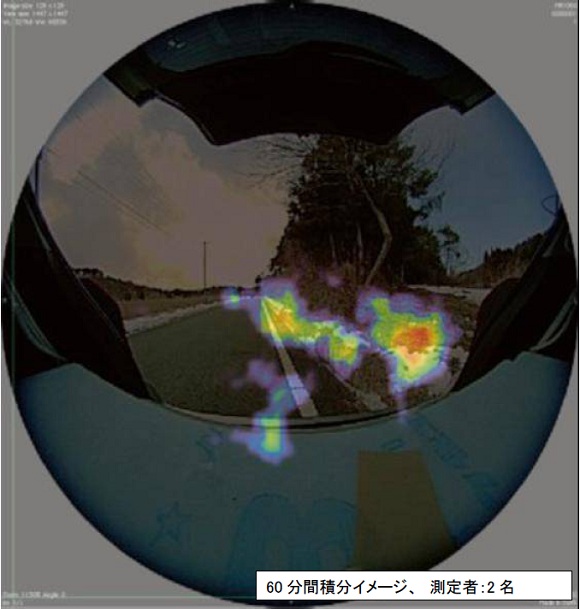
On March 29th, the Japan Aerospace Exploration Agency (JAXA) and the Japan Atomic Energy Agency announced that they have developed a prototype camera which detects gamma-ray emitting radioactive material such as cesium and shows the exposure distribution over an image. They hope that it can be used to make clean-up of contaminated areas around Fukushima Daiichi more efficient by locating places where radioactive matter has accumulated.
Gamma ray detectors used at accident sites have existed for some time, but this new prototype is said to be capable of much more precise readings. Using a wide-angle lens, the camera records an image and measures levels of cesium 137 and 134. The distribution is then shown on the image, using six different colors. In February, the prototype was tested in Itate Village in Fukushima Prefecture. Scientists measured radiation levels around supermarkets, roads and other public places to test the camera’s capabilities. At present, it measures not the absolute levels, but the relative levels by looking at highs and lows.
You may be wondering how JAXA got involved with this project. The technology used in the camera was developed as part of the next-generation astronomy satellite ASTRO-H, which will be equipped with a gamma-ray detector to observe the gamma bursts produced by dying stars going supernova. According to JAXA’s Dr. Tadayuki Takahashi, who invented the technology, “We are aiming to quickly turn this technology to practical use.”
Source:jaxa.jp(japanese) via Mainichi Shimbun (japanese)
 New research suggests even low-level radiation in Fukushima negatively impacting wildlife
 First worker to die from Fukushima radiation exposure officially recognized by Japan’s government
 Japan government makes cute illustrated version of radioactive isotope it plans to dump into sea
 Fukushima bottled water wins Gold Quality Award in the internationally coveted Monde Selection
 Common ramen ingredient found highly effective at clearing up radioactive contamination
 McDonald’s new Happy Meals offer up cute and practical Sanrio lifestyle goods
 Studio Ghibli glasses cases let anime characters keep an eye on your spectacles
 Studio Ghibli releases new action figures featuring Nausicaä of the Valley of the Wind characters
 All-you-can-drink Starbucks and amazing views part of Tokyo’s new 170 meter-high sky lounge
 We try out “Chan Ramen”, an underground type of ramen popular in the ramen community
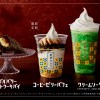 McDonald’s Japan releases a pancake pie for new retro kissaten coffeeshop series
 Our reporter takes her 71-year-old mother to a visual kei concert for the first time
 Starbucks reopens at Shibuya Scramble Crossing with new look and design concept
 Katsudon vs. tonkatsu vs. katsu sandwich – What’s the best way to eat pork cutlet in Japan?
 New sun protection mask becomes popular in Japan
 More foreign tourists than ever before in history visited Japan last month
 Disney princesses get official manga makeovers for Manga Princess Cafe opening in Tokyo
 Beautiful new Final Fantasy T-shirt collection on the way from Uniqlo【Photos】
 Is the new Shinkansen Train Desk ticket worth it?
 Foreign English teachers in Japan pick their favorite Japanese-language phrases【Survey】
 Beautiful Sailor Moon manhole cover coasters being given out for free by Tokyo tourist center
 Studio Ghibli releases Kiki’s Delivery Service chocolate cake pouches in Japan
 Japan’s bone-breaking and record-breaking roller coaster is permanently shutting down
 New definition of “Japanese whiskey” goes into effect to prevent fakes from fooling overseas buyers
 Our Japanese reporter visits Costco in the U.S., finds super American and very Japanese things
 Studio Ghibli unveils Mother’s Day gift set that captures the love in My Neighbour Totoro
 Domino’s Japan now sells…pizza ears?
 New Japanese KitKat flavour stars Sanrio characters, including Hello Kitty
 One of Tokyo’s most famous meeting-spot landmarks is closing for good
 Kyoto creates new for-tourist buses to address overtourism with higher prices, faster rides
 Sales of Japan’s most convenient train ticket/shopping payment cards suspended indefinitely
 Sold-out Studio Ghibli desktop humidifiers are back so Totoro can help you through the dry season
 Japanese government to make first change to romanization spelling rules since the 1950s
 Ghibli founders Toshio Suzuki and Hayao Miyazaki contribute to Japanese whisky Totoro label design
 Doraemon found buried at sea as scene from 1993 anime becomes real life【Photos】
 Tokyo’s most famous Starbucks is closed
 One Piece characters’ nationalities revealed, but fans have mixed opinions
 We asked a Uniqlo employee what four things we should buy and their suggestions didn’t disappoint
 Princesses, fruits, and blacksmiths: Study reveals the 30 most unusual family names in Japan
 Space agency in Japan has a surprising hidden girl in its visitor maps
 Trump’s announcement of America-Japan joint space exploration hypes up Japanese netizens
 Take a tour of the Fukushima Daiichi Nuclear Power Plant seven years after the disaster 【Video】
 TEPCO in hot water for use of tasteless hashtag in recent tweet about Fukushima Nuclear Plant
 Samsung prototype ‘Safety Truck’ uses all-weather screens to make driving safer, maybe
 JAXA paying people 380,000 yen to drop out of life for two weeks
 “Silence Straw” — Kyoto University raising money to fight noises caused by drinking straws
 The extreme lengths Samsung must go to make sure your Galaxy phone works perfectly
 Japanese politician announces plan to create space division for Self-Defense Forces
 Mobile purikura comes to your phone with new face-slimming lens
 Discovery of unregistered radioactive substance in Japanese university shocks students
 Japan chooses to go to the moon
 There’s now a moving Gundam anime robot model that you can control with your brain【Video】
 Japanese start-up invents faucet gadget to reduce water usage by up to 95 percent
 A vision of the future? We can’t take our eyes off Shimizu Corporation’s “Ocean Spiral” design
 Tokyo’s 7 coolest public art pieces
Leave a Reply